Download PDF Truth and Method
Why should be this e-book Truth And Method to read? You will never get the understanding and experience without obtaining by on your own there or attempting on your own to do it. Thus, reading this publication Truth And Method is required. You can be fine and also appropriate sufficient to obtain exactly how essential is reviewing this Truth And Method Also you consistently read by obligation, you could support yourself to have reading publication habit. It will be so valuable as well as enjoyable then.
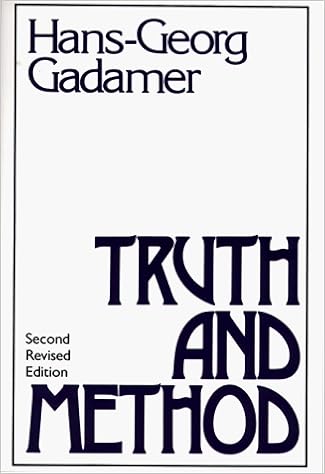
Truth and Method

Download PDF Truth and Method
Just what do you do to start reading Truth And Method Searching guide that you enjoy to read first or discover a fascinating publication Truth And Method that will make you intend to review? Everyone has distinction with their factor of checking out a book Truth And Method Actuary, reviewing habit should be from earlier. Lots of individuals might be love to review, yet not a publication. It's not mistake. A person will be tired to open up the thick publication with little words to review. In more, this is the real problem. So do occur possibly with this Truth And Method
Do you ever recognize the book Truth And Method Yeah, this is a really intriguing publication to review. As we informed formerly, reading is not sort of obligation activity to do when we have to obligate. Checking out ought to be a routine, an excellent routine. By checking out Truth And Method, you could open the new world and also obtain the power from the world. Every little thing can be acquired via guide Truth And Method Well in short, e-book is really powerful. As just what we offer you right below, this Truth And Method is as one of reading publication for you.
Regarding this book, everybody knows that it's truly fascinating publication. You may have sought for this publication in several shops. Have you got it? When you are lacked this publication to purchase, you can get it here. You recognize, obtaining Truth And Method in this internet site will be a lot easier. No need to go for buying in book stores, strolling from one store to others, this is the internet that has checklists al book collections worldwide, primarily. The web links are used for each book.
Interested in this publication is must. You could be other individuals that require the details and also information concerning the topic that have been written in this book. The Truth And Method issue concerning the intriguing topic related to the problem today. When you have actually made a decision to acquire this book, you can check out the link right here. It will straight concern you to gain the book as your own. As well as the soft data is just what you could provide to you. Allow's obtain guide and also read it now.
Review
"As a contribution to our understanding of understanding, it ranks with the work of Pierce, Husserl, Cassirer, Wittgenstein, Polanyi, and Lonergan as a highpoint of twentieth century reflection upon the constitutive conditions of knowing....It is impossible to praise the work too highly."—The Thomist"The single-most important study of the origin, development, and nature of the concept and meaning of 'hermeneutical consciousness' extant."—Review of Metaphysics"No one interested in hermeneutics and historical understanding can justify neglecting Truth and Method. Gadamer not only reinterprets the history of modern hermeneutics, but he offers his own phenomenology of understanding....His is our century's most creative and ambitious attempt to exorcise the demon of historicism."—Journal of the American Academy of Religion"One of the major contributions to literary theory of the last few decades....It is a defense of the truth value of texts that seeks to accomodate both the process of historical consciousness and the contingency of the individual subject."—ACLA Newsletter
Read more
About the Author
Hans-Georg Gadamer was born on 11 February 1900 and died on 13 March 2002. He was the author, most notably, of Truth and Method, and, more recently, of The Beginning of Philosophy and The Beginning of Knowledge.
Read more
Product details
Paperback: 594 pages
Publisher: Continuum; 2nd Revised edition (June 1, 2004)
Language: English
ISBN-10: 0826405851
ISBN-13: 978-0826405852
Product Dimensions:
6 x 1.5 x 8.8 inches
Shipping Weight: 1.9 pounds
Average Customer Review:
4.1 out of 5 stars
35 customer reviews
Amazon Best Sellers Rank:
#297,700 in Books (See Top 100 in Books)
Truth and Method is one of the most important works of philosophy of the 20th century, and this revised translation by Weinsheimer and Marshall is the authoritative translation. I give both the work and the translation a 5+ star rating. This edition, however, has mistakes all over the place; they obviously scanned the pages of the Continuum edition and did little to no proof reading. (For example, key German terms are misspelled.) The font is also horrible and the line spacing is weird; and there are no margins to write in. Spend the money and buy the Continuum edition.
This is one of those great moments where a great student follows his master (Heidegger) yet gives us a new product and not simply a repetition of his master. In short, for Gadamer language is the horizon of being. As Kant was wrong to seek a thing-in-itself, so we also should beware of a "meaning-in-itself."Gadamer begins and ends his work on a strange note: the aesthetics and interpretation of art. It’s not that art determines how we interpret text, but art allows Gadamer to illustrate (no pun intended) the tension given that great works of art are considered “timeless,†yet they were produced in historical, finite circumstances. This tension points to the horizon, a key Gadamerian term.Every experience has implicit horizons of before and after and finally fuses with the continuum of experiences present in the before and after to form a unified flow of experience (246). Df. horizon = not a rigid boundary but something that moves with and invites one to advance further. Everything that is given as existent is given in terms of a world and hence brings the world horizon with it. As a horizon phenomenon “world†is essentially related to subjectivity, and this relation means also that it exists in transciency.â€Hermeneutical circle: possesses an ontological positive significance. We have already fore-projected before we even approach the text. This creates an openness which situates our meaning with other meanings. Understanding is a participation in the event of tradition and not so much a subjective act (302).Horizons are temporally-conditioned. Time is not a gulf to be crossed by a supportive ground in which the present is rooted. We cannot stand outside of our situation. “All self-knowledge arises from what is historically pre-given, what Hegel calls “substance’†(313). Horizon: every finite present has its limitations. Every situation represents a standpoint that limits the possibility of vision. Horizons move with us. When we understand something, we fuse the horizons between text and interpreter. Fusion of horizons: We regain concepts of a historical past in such a way that it also includes our own comprehension of them (382).This will go down as one of those truly great books. Ground-breaking works. It’s not super-hard to read simply because it is well-written. However, he does presuppose a good bit of Hegel and Heidegger, so keep that in mind.A note about the reprint: I have the Bloomsbury edition and the text is fine. SHucks, I even got mine used. Yes, the spine willl crease when you read it, but that's true of most books. The spine, though, will not break.
Gadamer's Truth and Method is a long, dense, and richly informative effort to find a solid and rational basis for understanding in the human sciences or Geistenwissenschaften. Gadamer proceeds from the observation that efforts to adapt experimental methods used in the natural sciences, as well as sophisticated statistical models employed with less success but with just as much commitment to rigor in economics and related disciplines are, by their very nature, ill-suited to his objective. Gadamer is, of course, correct, though he puts himself in a position that die-hard proponents of quantitative techniques and the mathematical expression of lawfulness judge to be hopelessly problematic. Nevertheless, Gadamer persists. Whether or not he succeeds is inevitably a judgment call, but I'm inclined to view his efforts as fruitful, providing a persuasive methodological foundation for research in disciplines wherein well-informed interpretation necessarily takes the place of model building and testing.Gadamer's book, first published in 1960, represents a lifetime of scholarship, covering western philosophy from the ancient Greeks to the time of Truth and Method's publication. Gadamer's mastery of material pertinent to his task has rightly been characterized as encyclopedic, but it is also suitably focused, especially through application of the hermeneutic method, broadly speaking. With regard to questions such as what does it mean to be a thinking, feeling human being who actively interprets and contributes to creating the circumstances that give life meaning, Gadamer proposes that we seek a thorough understanding of the tradition of which we, as socially created entities, are manifestations.Without trivializing Gadamer's conclusions or misinterpreting their methodological and substantive import, it seems reasonable to conclude that he is referring to a process that is conspicuous in the social sciences, especially as understood by ethnographers, namely socialization in linguistically rich environments. Each of us is born and raised in an historically specific time and place that can reasonably be construed as having an interpretable shared culture, an ensemble of prescriptions, prohibitions, commonplace explanations, ways of making inferences, and modes of understanding to which consociates refer in making sense of what it means to be. Emile Durkheim's concept of the collective conscience and George Herbert Mead's generalized other are products of socialization into a specific socio-cultural milieu and can be construed as closely approximating tradition as Gadamer understands that idea. In a more critical vein, a similar claim can be made for Antonio Gramsci's concept of cultural hegemony. Thus, in Gadamer's view, "history does not belong to us; we belong to it. Long before we understand ourselves through the process of self-examination, we understand ourselves in a self-evident way in the family, society, and state in which we live" (Gadamer, 1998: 276). The language we use in understanding ourselves, moreover, in not merely a tool that we use, language is constitutive of being human.Research with reference to an identifiable tradition, a specific collective consciousness or generalized other is best done interpretatively, through application of historical methods or qualitative anthropological techniques to achieve hermeneutic understanding of the varying conditions of life as they are experienced and understood by concrete human beings. Given this orientation to making sense of one's place in the world, growing interest in historical and, especially, ethnographic applications and the consequences of their use has produced a good deal of contemporary interest in Gadamer's work and in hermeneutics generally.Gadamer has been challenged by Habermas and others as being insufficiently specific as to the meaning of tradition. In this critical view, complex modern societies are not characterized by one stable and homogeneous tradition shared by all. Instead, divisions such as class, race, ethnicity, native tongue, and religion assure a multiplicity of different and changing traditions for any time and place.While there is merit to this critique, I think it is often overdrawn, ignoring the fact that Gadamer's approach is readily applicable to co-existing but varied socio-cultural configurations for any time and place. Were we to completely discount Gadamer's approach for the reasons given by Habermas, we would also be obliged be reject Max Weber's use of ideal-typical analysis of social systems; an unlikely event, indeed.Truth and Method requires a substantial commitment of time and effort, and Gadamer devotes a lot of attention to failed alternatives to his hermeneutic approach to establishing truth in the human sciences. In short, he does not cut to the chase but gives a history of the varied philosophical routes that others have tried over the course of millenia to find a compelling methodological basis for achieving understanding in the human sciences. Nevertheless, the richness of the material makes reading it and thinking about it worthwhile. However, those of us who lack a strong background in philosophy will gain less than better informed readers.
The book itself is terrible quality. It's required reading for one of my classes, and many of my classmates' books are falling apart. Mine has fallen apart into three separate pieces.Not recommended if you plan to write in the book (although practically impossible in such small margins).The text can be pretty dry (and there's nothing wrong with that) but it's as if the font tries to beg that it's not, and that's a little conflicting when trying to read it.
This version has many, many typos. It looks like it was never proofed. Just get the other version...this one is not the best. Plus, the font makes you want to gouge your eyes out.
Truth and Method PDF
Truth and Method EPub
Truth and Method Doc
Truth and Method iBooks
Truth and Method rtf
Truth and Method Mobipocket
Truth and Method Kindle

Tidak ada komentar:
Posting Komentar