Download PDF The Security Development Lifecycle (Developer Best Practices)
We know that you are also fan of the author of this publication. So, it will not be worse for you to select it as referral. The Security Development Lifecycle (Developer Best Practices), as one of the vital books to review can be thought about as a publication that offers you something advised. You could take the comparable subject from other publication, but the one that can provide you much better perception is this publication. This condition will truly influence you to offer the reputable selection.
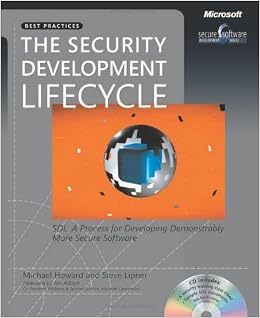
The Security Development Lifecycle (Developer Best Practices)

Download PDF The Security Development Lifecycle (Developer Best Practices)
Discover the strategy of doing something from numerous resources. Among them is this book qualify The Security Development Lifecycle (Developer Best Practices) It is an effectively understood publication The Security Development Lifecycle (Developer Best Practices) that can be recommendation to read currently. This advised book is among the all fantastic The Security Development Lifecycle (Developer Best Practices) collections that are in this site. You will likewise discover various other title as well as themes from various authors to search below.
When you require a book to check out now, The Security Development Lifecycle (Developer Best Practices) can be a choice since this is among the updated books to check out. It is sure that when you have new point to consider, you need inspirations to resolve t. and when you have time to read, the books turn into one solution to take. Even this book is taken into consideration as new book, many individuals place their trusts on it. It will certainly recognize you to be among them that are falling in love to read.
Asking why? You have actually seen that this site teems with excellent publications from variant releases a collections on the planet. Getting a restricted edition publication is additionally very easy here. You can locate The Security Development Lifecycle (Developer Best Practices), as example to be your turn and your choice now. Due to the fact that, we will not conceal anything concerning it here. We provide you all the very best from The Security Development Lifecycle (Developer Best Practices) that the author developed especially for you.
Never ever bother with the material, it will coincide. Perhaps, you could get more advantageous benefits of the methods you review guide in soft file types. You recognize, think of that you will certainly bring the book anywhere. It's so heave. Why you don't take easy ways by establishing the soft file in your device? It is so easy, right? This is additionally one factor that makes lots of people choose to pick this book also in the soft file as their analysis products. So currently are you thinking about?
From the Publisher
The software industry is clamoring to learn more about the SDL methodology. With insights direct from Microsoft’s security team, where these techniques have been developed and proven to help reduce code defects, this book premieres SDL to a worldwide audience and is the first to detail the methodology stage by stage. Key Book Benefits: • Delivers practical, proven advice from the experts for minimizing security-related code defects • Details a methodology that can be applied to any development process, with outstanding results • Includes a CD-ROM with video training classes for developers conducted by coauthor Michael Howard, a security program manager at Microsoft
Read more
About the Author
Steve Lipner, CISSP, is the senior director of Security Engineering Strategy for Microsoft. He is responsible for defining and updating the Security Development Lifecycle and has pioneered numerous security techniques. Steve has over 35 years’ experience as a researcher, development manager, and general manager in IT security.
Read more
Product details
Series: Developer Best Practices
Paperback: 352 pages
Publisher: Microsoft Press; 1 edition (June 28, 2006)
Language: English
ISBN-10: 9780735622142
ISBN-13: 978-0735622142
ASIN: 0735622140
Product Dimensions:
7.4 x 1.2 x 9 inches
Shipping Weight: 1.5 pounds (View shipping rates and policies)
Average Customer Review:
3.7 out of 5 stars
6 customer reviews
Amazon Best Sellers Rank:
#1,198,768 in Books (See Top 100 in Books)
I was hoping to find a lot of answers in this book. Unfortunately, I failed to check the Copyright date (2006).I'm sure this was groundbreaking in 2006. Today, however, there is better information available on-line... with all the usual caveats of consuming anything on-line.
This book is a wonderful glimpse behind the curtain at one of the most advanced software development firms in the world. Renowned for hiring the best and the brightest, this book shows how they learned to do development in a smarter and more efficient manner. Some people may consider a SDL to be overkill, but the evidence presented is clear; if you want an efficient, effective process for meeting customer requirements, one must consider and address security. And this book is the how-to companion to the other great titles associated with Microsoft and secure coding. Whereas Writing Secure Code, Second Edition, focuses on technical detail, this book focuses on the process that enables developer to achieve the technical details.This book is the project manager's guide to how it should be done. How to set up your development processes so that better developers can contribute in an effective fashion towards making better software. For some, there are no new secrets revealed in this book, but I know of no other source with all this information together in one place. And it comes with a bonus - the material has been tested and proven at the world's largest developer group. And in this case, bigger is not easier, but much harder - decentralized bureaucracies and business unit independence aside, it works at Microsoft, and as it gets further embedded into their processes and systems, the future for this methodology looks better and better.Thank you Mike Howard and Steve Lipner for finishing the story. First we learn what to do (Writing Secure Code), now you let us know how to get it done (The Security Development Lifecycle). This may not be the perfect book, but then, I've yet to see that one. This book does advance the management side of the state-of-the-art light years forward, into the current century. This book is the textbook for the process side of software engineering in my classes, and I look forward to future editions and more details from behind the curtain.
Well ten with many excellent examples.This is the place to start if you're interested in developing secure software or reviewing systems for security and re3liability.
I read six books on software security recently, namely "Writing Secure Code, 2nd Ed" by Michael Howard and David LeBlanc; "19 Deadly Sins of Software Security" by Michael Howard, David LeBlanc, and John Viega; "Software Security" by Gary McGraw; "The Security Development Lifecycle" by Michael Howard and Steve Lipner; "High-Assurance Design" by Cliff Berg; and "Security Patterns" by Markus Schumacher, et al. Each book takes a different approach to the software security problem, although the first two focus on coding bugs and flaws; the second two examine development processes; and the last two discuss practices or patterns for improved design and implementation. My favorite of the six is Gary McGraw's, thanks to his clear thinking and logical analysis. The other five are still noteworthy books. All six will contribute to the production of more security software."Security Development Lifecycle" (SDL) is unique because in many ways it exposes the guts of Microsoft's product development process. I cannot recall seeing another technical company share so much of its internal procedures with the public. One of the most interesting aspects of SDL is the attention paid to security after a product is shipped. No one at Microsoft breathes a sigh of relief when boxes appear on store shelves. Instead, Microsoft explains how it conducts security response planning in ch 15 and security response execution in ch 17. (Between the two is ch 16 -- only 3/4 of a page! Why bother?)Although I liked SDL overall (enough to justify 4 stars), I thought it suffered three major problems. First, I don't think the audience was defined properly. p xviii mentions "managers" as the primary target, along with architects and designers. Specifically, "this is not a book for developers." Yet, ch 12 ("Secure Testing Policies") is definitely for programmers. A manager probably not going to know what a "null pointer dereference" is; at the very least that is not a subject that should be discussed in a book for managers.Second, I think SDL suffers a little too much overlap with the earlier Microsoft book "Writing Secure Code, 2nd Ed." WSC2E addressed writing documentation, security testing ,and obviously secure coding in much the same language as repeated in SDL. Sometimes repetition is justified, but perhaps those subjects appeared in WSC2E for a reason and did not belong in a book for managers.Third, and most importantly, Microsoft continues its pattern of misusing terms like "threat" that started with "Threat Modeling" and WSC2E. SDL demonstrates some movement on the part of the book's authors towards more acceptable usage, however. Material previously discussed in a "Threat Modeling" chapter in WSC2E now appears in a chapter called "Risk Analysis" (ch 9) -- but within the chapter, the terms are mostly still corrupted. Many times Microsoft misuses the term risk too. For example, p 94 says "The Security Risk Assessment is used to determine the system's level of vulnerability to attack." If you're making that decision, it's a vulnerability assessment; when you incorporate threat and asset value calculations with vulnerabilities, that's true risk assessment.The authors try to deflect what I expect was criticism of their term misuse in previous books. On p 102 they say "The meaning of the word threat is much debated. In this book, a threat is defined as an attacker's objective." The problem with this definition is that it exposes the problems with their terminology. The authors make me cringe when I read phrases like "threats to the system ranked by risk" (p 103) or "spoofing threats risk ranking." On p 104, they are really talking about vulnerabilities when they write "All threats are uncovered through the analysis process." The one time they do use threat properly, it shows their definition is nonsensical: "consider the insider-threat scenario -- should your product protect against attackers who work for your company?" If you recognize that a threat is a party with the capabilities and intentions to exploit a vulnerability in an asset, then Microsoft is describing insiders appropriately -- but not as "an attacker's objective."Don't get me wrong -- there's a lot to like about SDL. I gave the book four stars, and I think it would be good to read it. I fear, though, that this is another book distributed to Microsoft developers and managers riddled with sometimes confusing or outright wrong ways to think about security. This produces lasting problems that degrade the community's ability to discuss and solve software security problems. I also question the implication that SDL is great and everything else doesn't produce verified security improvements. I can understand denigrating Linux, but is Microsoft afraid to acknowledge the security record of an OS like OpenBSD?
The Security Development Lifecycle (Developer Best Practices) PDF
The Security Development Lifecycle (Developer Best Practices) EPub
The Security Development Lifecycle (Developer Best Practices) Doc
The Security Development Lifecycle (Developer Best Practices) iBooks
The Security Development Lifecycle (Developer Best Practices) rtf
The Security Development Lifecycle (Developer Best Practices) Mobipocket
The Security Development Lifecycle (Developer Best Practices) Kindle

Tidak ada komentar:
Posting Komentar